Modernizing telecom billing systems with real-time event streaming
By Eric Newcomer, Principal Analyst, Intellyx
Every telecom bill starts with recording an event – a phone call, text message, or stream of data. Each call detail record (CDR), usage detail record (URD), or Internet protocol detail record (IPDR) eventually produces a consumption charge on a telecom bill.
How and when a telecom billing system processes each network consumption event and creates bills has a significant impact on cost and customer service. Traditional telecom billing systems collected CDRs in files and processed them in monthly batches. But modern systems process CDRs, URDs, and IPDRs as real time events and have the flexibility to present simplified bills that are easier to understand.
Modern billing systems process network consumption events in real time so that a customer’s account is always current. Modern systems also support a variety of different billing methods – whether per call or per text, or a flat rate for a given geographical region or time period. When a customer pays for a specific amount of calls, texts, or data, the billing system has to know in real time when the limit is reached.
The challenge for both existing and new telecom companies is how best to modernize an older billing system designed to process a monthly batch of CDRs to a modern system designed to process CRDs, UDRs, and IPDRs in real time.
Traditional Billing Systems
Core components of a telecom billing system include usage collection and rating, customer and product management, invoice generation and delivery, and payment processing, among others.
Telecom billing systems typically also integrate with enterprise CRM and ERP systems to define and update service types (voice, data, SMS), apply pricing policies, manage customer data, generate accurate bills, and facilitate payments.
Billing system components originally ran in a single, monolithic application designed to batch process CDRs, as shown in the following (simplified) illustration.
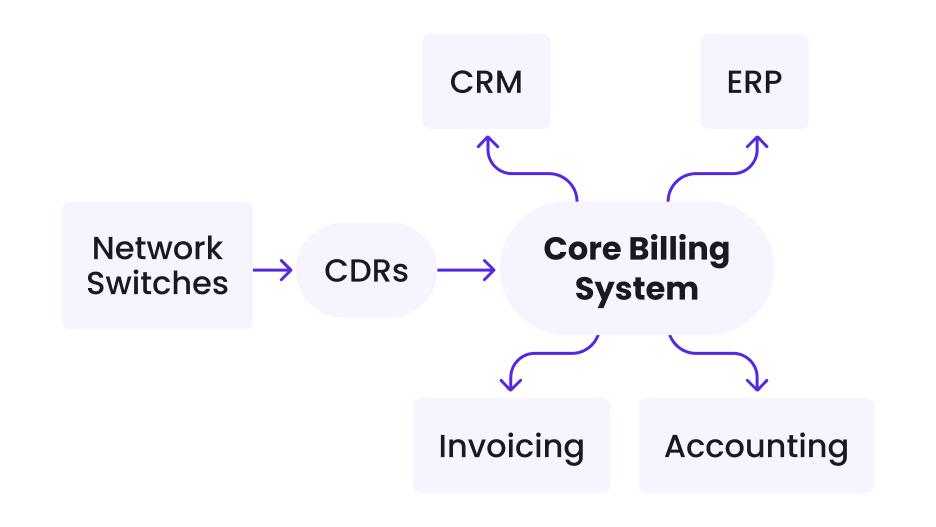
The diagram depicts a traditional telecom billing system, designed for voice traffic over twisted pair copper wires. In those days of course there was a single, fundamental telecom product (with minor variations such as call waiting, three-way calling, and so on), and these billing systems were relatively simple as a result.
This type of billing system is widely adopted and often the starting point for a modernization project, especially when the organization is an established telecom provider, or a new provider starting with an established billing software package.
Incremental Modernization
Modernization is rarely done all at once as a “big bang” event. Instead, it’s usually done incrementally with a lot of testing to be sure the components of the new system works as well, if not better than, the old system.
In the case of modernizing a telecom billing system, systems set up to bill for telephone calls have very different characteristics than systems designed to support modern telecommunication and internet traffic.
An event driven architecture (EDA), a style of integration system that processes events in real time, is a good match for these different characteristics, and therefore a good foundational starting point for a modernization project, for example to enter the mobile virtual network operator (MVNO) market.
You may want to keep or use an existing billing system, and add new capabilities with new application components for the new market.
Many of the capabilities and features you need for the new service may already exist, in part if not in the whole, within your IT environment, or within a commodity billing platform. All you need to do is figure out which new components to add to get the new billing capabilities you need and define the integration points.
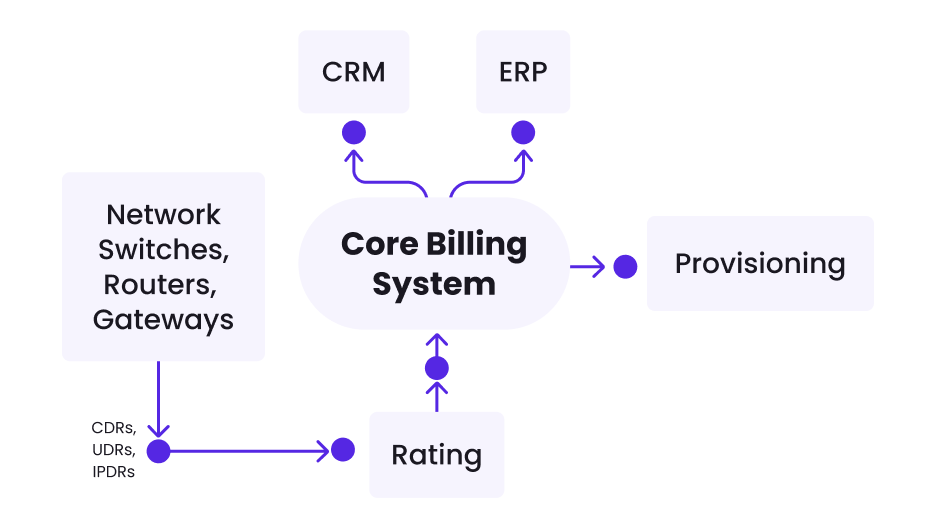
The illustration above (again, simplified) depicts a fundamental architectural shift that supports incremental modernization. The shift is from batch file processing to individual event processing using an EDA system such as Wavelo.
(Queues in the illustration represent event topics. When a consumption event is written to a topic, an application component listening for such an event will read in and process the event data.)
Modern billing systems (such as Wavelo) are designed to process individual events in real time and also enable dynamic and flexible event routing, for example to new billing system components as they are introduced, such as a new rating engine that understands modern billing plans and consumption records, or a new provisioning system that can handle mobile and satellite networks.
Modern Billing Systems
Incorporating new capabilities and functionality to modernize your system or add new services, seamless and effective integration supports targeted, incremental migration, but it also provides an approach to achieve comprehensive modernization.
An EDA simplifies integration with multiple components and supports the flexibility to choose which components to add to an existing system. Over time other components can be replaced and modernized without disrupting the system until the entire system is modernized.
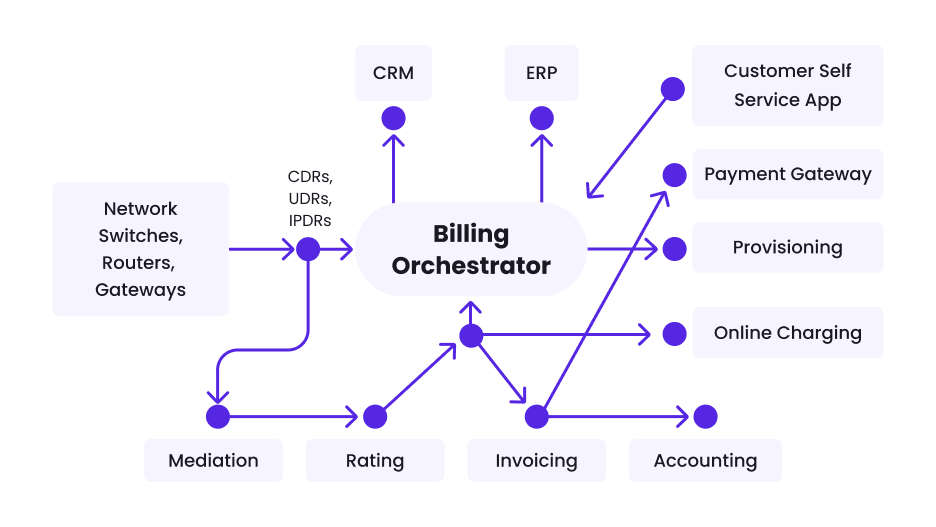
The illustration above depicts (again, simplified) a completely modernized telecom billing system in which an orchestrator replaces the core engine, and uses events and APIs to coordinate processing across multiple components.
By substituting batch file handoffs with event queues and APIs, network consumption events are easily routed and re-routed easily to the new components as they are introduced.
The Intellyx Take
Modern telecom billing systems need to capture and process network consumption events in real time to accurately measure consumption based billing plans and limit such consumption when it reaches any set limit.
EDA based billing systems such as Wavelo introduce flexibility and adaptability traditional batch based systems lack. It's far easier to introduce new applications and functionality incrementally using event topics or queues and APIs than it is to re-engineer entire batch systems all at once.
This approach supports incremental modernization, which is typically easier to introduce and validate than a complete “big bang” rewrite of a critical core system, making it easier to incorporate best of breed components.
Leveraging APIs to wrap legacy capabilities during a modernization project also supports the transition to an external product catalog. A real-time mediation layer collects and enriches events in real-time, and streams data in the right format for gen AI training.
Modern telecom billing systems such as Wavelo leverage modern EDA and API based systems to support incremental modernization for telecom companies entering new markets or adapting to them.
Copyright © Intellyx BV. Wavelo is an Intellyx customer. Intellyx retains final editorial control of this article. No AI was used to write this article.
